

Secret Recipes
Part 1 - Introduction

The following text with accompanying illustrations is an updated version of a presentation I gave in January 2006 to the Hofmann LSD Symposium in Basel, Switzerland. The subject is one I had been thinking about for quite some time, since my first reading of The Road to Eleusis in the early ‘80s.
Although the proposal by Hofmann, Ruck, and Wasson in Road was quite astonishing for me, and many others too, it didn’t seem to solve the mystery definitively. The case presented for the grain-infesting fungus ergot being a secret ingredient of the kykeon — the secret and psychoactive potion used in the yearly autumnal Eleusis celebration — was strong in certain respects, but insufficient in others.
I had worked with Ipomoea (morning glory) alkaloids in Mexico in the late ‘60s and also perfected a procedure for “underground chemists” to hydrolyze ergot alkaloids to lysergic acid. I therefore had read most of the relevant literature on the subject of ergot alkaloid hydrolysis, and one paper in particular stuck in my mind. It described the discovery of ergine, the simplest amide of lysergic acid. Ergine and its epimer isoergine are the main components of the alkaloid mixture of several Ipomoea species. I shall return to that subject presently.
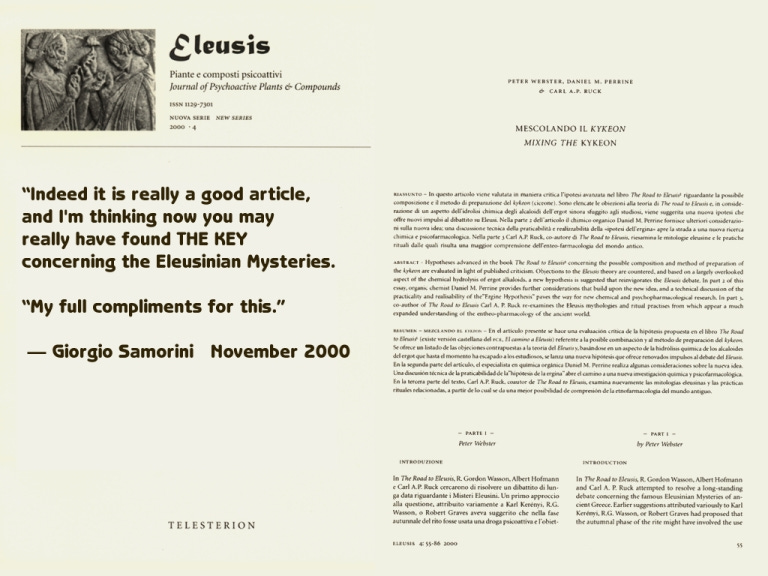
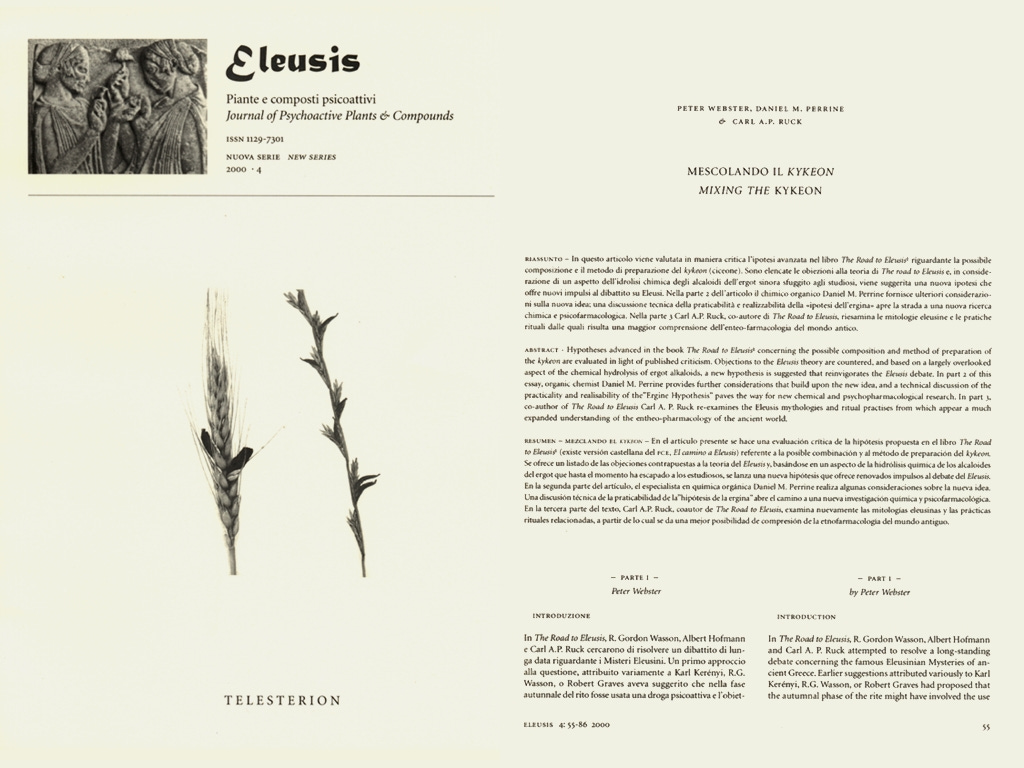
My musings about Eleusis and the kykeon led finally to my publication, with Dan Perrine, author of The Chemistry of Mind-Altering Drugs and Carl Ruck, co-author of The Road to Eleusis, of a paper in the journal Eleusis titled “Mixing the kykeon“. Psychedelic chemist Dave Nichols also kindly assisted us in working out the chemical mechanism shown in the illustration in the paper. The principal idea of the paper was the hypothesis that the Eleusis priests had developed a method to chemically treat ergot so as to eliminate its toxicity and at the same time dramatically increase its potency as a psychoactive, psychedelic, or, as in more spiritual terminology, entheogenic entity.
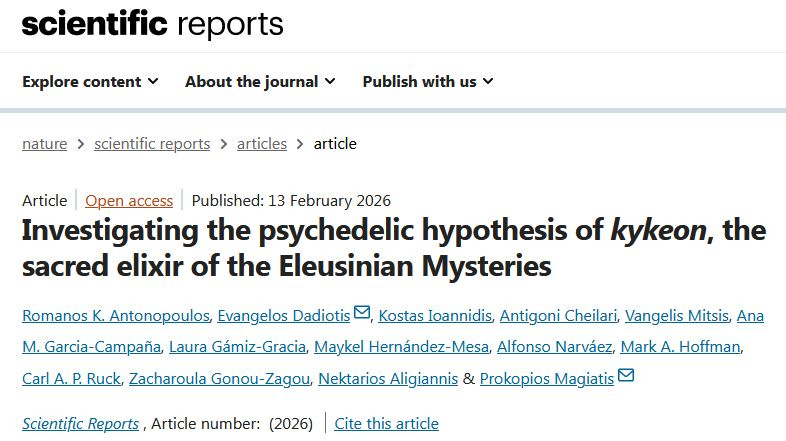
The impetus for revisiting this topic here is a recent and gratifying development. Twenty-five years had gone by since we published “Mixing the kykeon“ and despite several attempts at getting a suitably equipped chemist to run some tests to either confirm or discredit our hypothesis, nothing had come of it.
In February of this year, 2026, it has been reported in Nature that exacting laboratory testing and analysis has finally confirmed the hypothesis of “Mixing the kykeon“: that a simple chemical procedure that would have been possible for the Eleusis priests to perform, does indeed convert the toxic ergot alkaloids in ergot to the psychoactive products ergine and isoergine.
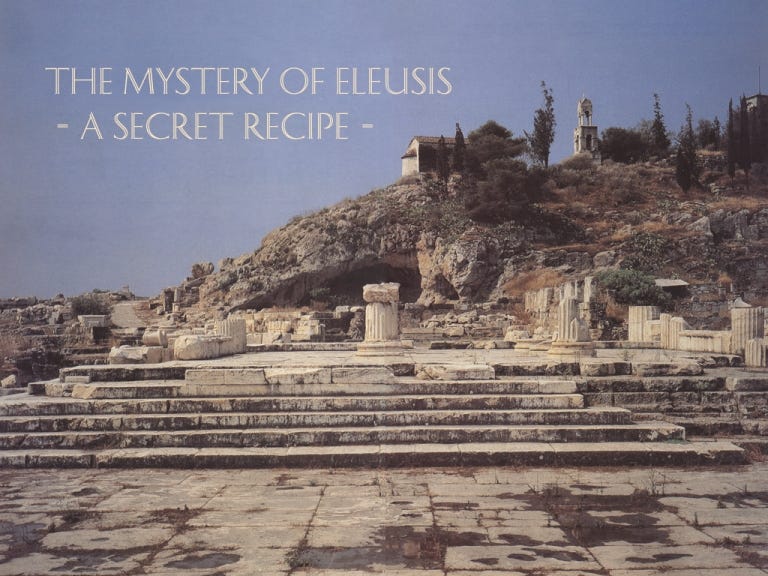
The Mystery of Eleusis – A Secret Recipe
Presentation to the Hofmann LSD Symposium,
Basel, January 2006
Long-enduring mysteries may sometimes acquire a certain charm, or even charisma – something we would normally only associate with a personality. Indeed, when a notorious mystery is finally solved we may feel emotionally distraught – as if an old friend had suddenly left us forever.
In our hearts we love our mysteries, and often really do not want them solved, especially if that solution turns out to be something that might well have been discovered long ago.
The messenger who brings news of a mystery’s demise may therefore not be believed, he may even be dismissed as a fool for having dared to tread where so many heroes had explored but come back empty-handed. How dare this presumptuous upstart try to take our beloved mystery from us!
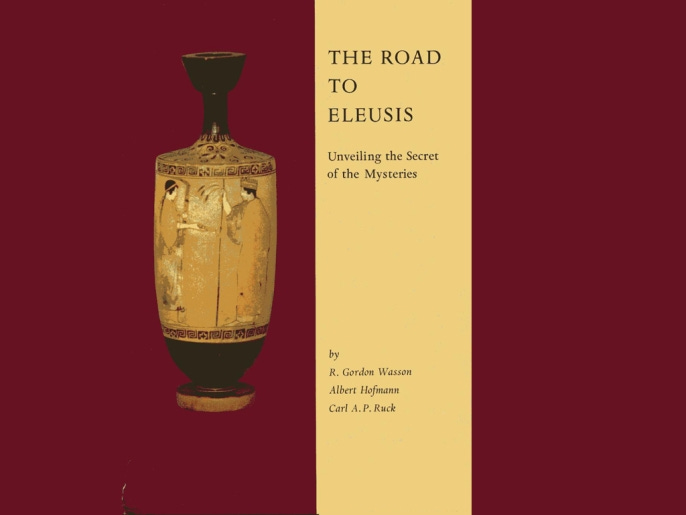
The reception that The Road to Eleusis first encountered was not far from that. The book and its authors were misinterpreted, misquoted, mis-reviewed and mistook as mere pretenders to expertise on the age-old question that so many famous names had tried, and failed to answer.
And not to mention, ignored. As Carl Ruck wrote to me when I was composing a review of the 20th Anniversary Edition of The Road to Eleusis,
The book excited no interest amongst colleagues in my profession, and rarely has anyone even mentioned it to me... The discussion of Dionysos and Greek wine, including the symbolic significance of the thyrsos, has been completely ignored by Classicists; and the work on Eleusis rarely earns even a disparaging footnote in treatments of Greek religion. More recently, the Eleusinian Mystery has been expropriated for the curriculum in Women’s Studies, but despite the grain Goddess, ethnobotany is not on their agendum; and they, too, don’t speak to me. Students who work with me have been warned that they will be blacklisted. My textbooks in grammar, as well, as if by contagion, are viewed by some as suspect and a threat to normalcy.
It wasn’t until many years later that a very positive appraisal of The Road to Eleusis was finally published in a major journal.
The author of this article, Shawn Eyer, concluded that,
The Wasson-Hofmann-Ruck theory is perhaps the first truly realistic explanation for the most-documented aspect of the sacred mysteries: their profound, beneficial and lasting effects upon the millions of initiates who, at one time or another, stood enraptured on the steps of the torch-lit Telesterion.
A careful reading of this essay, however, revealed that the mystery of Eleusis was still not totally solved, at least not in its chemical and pharmacological dimensions.
And perhaps in response to this article, Ivan Valencic the following year published a criticism of the Eleusis theory that centerd on that very topic – the chemical and pharmacological nature of the kykeon, the secret sacramental drink of The Greater Mysteries of Eleusis.
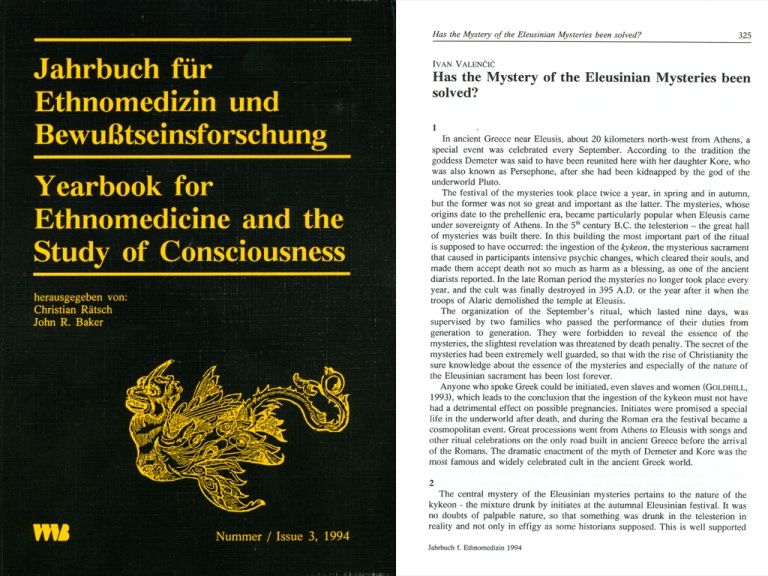
After a detailed and convincing critique, Valencic concluded that he agreed with ROBERT GRAVES and TERENCE McKENNA that Psilocybe mushrooms and not ergot might have been the psychoactive secret of the kykeon.
Having been a devotee of the Wasson-Hofmann-Ruck hypothesis since I first read The Road to Eleusis in 1980, Valencic’s criticisms seemed to need some rebuttal, and to that effect I wrote a paper for my website, The Psychedelic Library.
The paper I wrote, “The Secret of the Kykeon”, attempted to show that, despite some problems, the ergot fungus should still be considered as the first choice for the kykeon’s psychoactive ingredient. At the time, however, I had no further ideas on how the ergot hypothesis might be improved.
It wasn’t for a few more years, while discussing the topic by email with Dan Perrine and Dave Nichols, that I quite suddenly remembered some old references I had read about how lysergic acid was first isolated from reaction mixtures. In an effort to elucidate the molecular structure of these compounds, researchers had been studying how the natural alkaloids of ergot were cleaved into various fragments. One of these reactions was the basic hydrolysis of the alkaloids of ergot.
This work had been done in the 1930s, and certain aspects of it had apparently been all but forgotten by some researchers ever since.1
What the work showed was that the predominant alkaloids of ergot, the toxic and ergotism-producing ergopeptines such as ergotamine, could be partially hydrolyzed to ergine rather than completely hydrolyzed to lysergic acid, depending on the conditions of the reaction.
I realized that these findings might have finally provided the missing link for how the preparation of the kykeon could have been accomplished. It seemed that with quite a simple procedure, the entire alkaloid content of ergot could be converted to a simple and psychoactive lysergic acid derivative called ergine.
With Dan Perrine and Carl Ruck I soon published a paper in ELEUSIS detailing my findings, and proposing a recipe for how the kykeon might have been prepared by the Eleusis priests. Giorgio Samorini, the editor and publisher of the journal was so generous as to write me that,
“Indeed it is really a good article, and I’m thinking now you may really have found THE KEY concerning the Eleusinian Mysteries. My full compliments for this.”
— Giorgio Samorini November 2000
It was certainly not forgotten by Albert Hofmann, who mentioned the work of Smith and Timmis, and Jacobs and Craig, in My Problem Child. “Lysergic acid amide [ergine] was described for the first time by the English chemists S. Smith and G. M. Timmis as a cleavage product of ergot alkaloids...” (page 90)