

Capitalism - Trapped While We Slept!
We're all Bhopalers Now - Another Chapter of the Methyl Isocyante Series

A joke I remember from many years ago has the star of the tale, traveling in his automobile to a destination in a distant town in search of a certain attraction he has heard word of. Call it Shangri-La. Arriving on the outskirts of the town but not knowing exactly where in the town the place is located, he sees an old-timer rocking on his porch and figures to ask directions. To cut a long joke short, the old-timer starts to describe the way to Shangri-La but quickly realizes that the route he is describing won’t work, fault of some one-way traffic circle or the like. Several more attempts at directions arrive at the same checkmate. Frustratingly he says, “You know, it seems really weird, but YOU JUST CAN’T GET THERE FROM HERE.”
An apt description of where we are today, riding along in our AUTOMOBILES, immersed in the trap of Capitalism, asking the experts or even passers-by if we can’t somehow get to where we all want to go, a place where things make sense. Sense in an ecological, in a human sense.
Another hilarious version of the same allegory was performed by a famous French stand-up artist, Raymond Devos. Listen here (in French, where its humor and delivery are impeccable):
In this version Ray is driving in his car, presumably in Paris, and he gets sucked into one of Paris’ immense roundabouts. Perhaps it is this one, The Arc De Triomphe Traffic Circle:
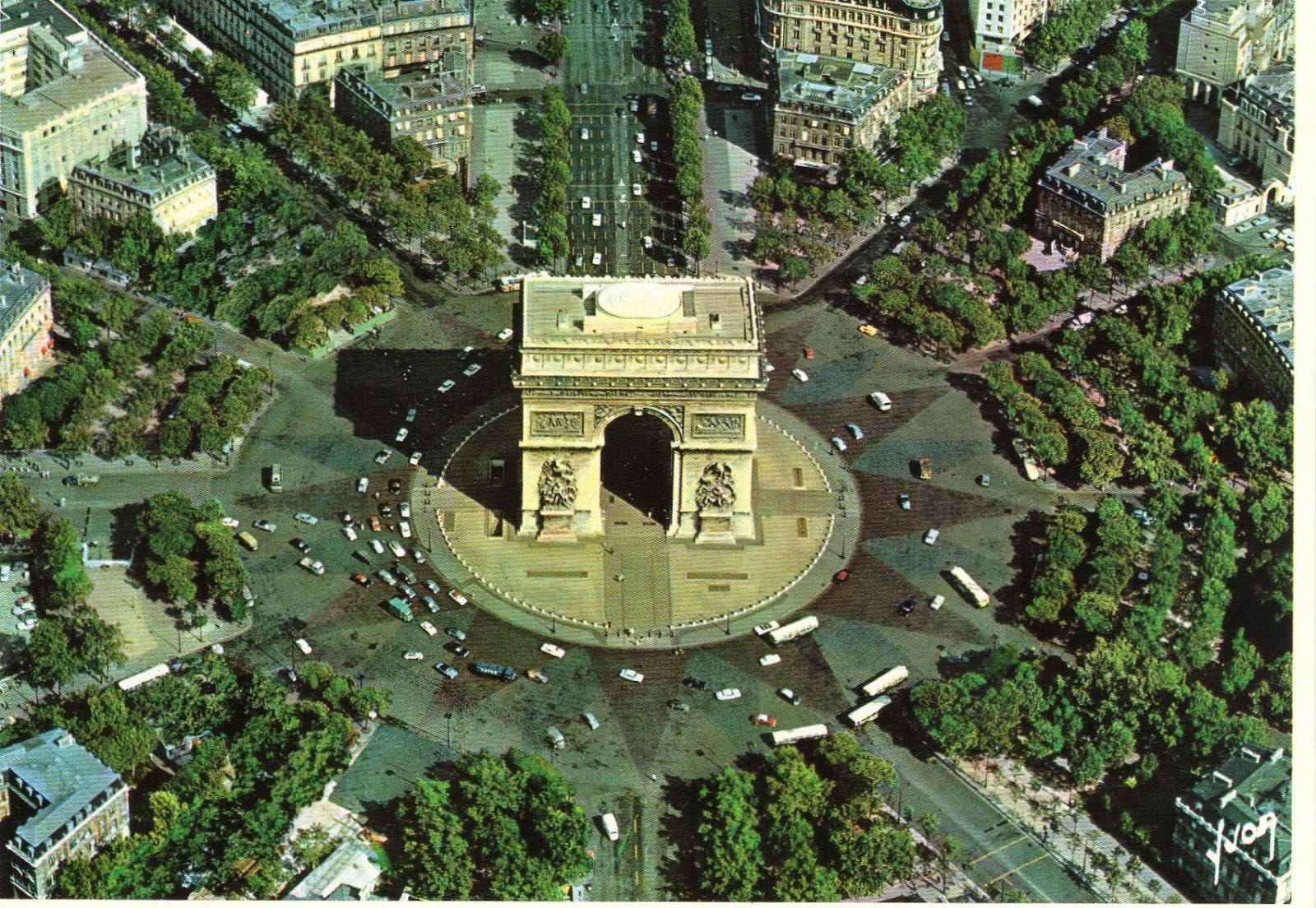
Once in, he discovers that all roads he might take to exit the circle are “sens interdit,” one-way INTO the traffic circle and he has no choice but to “circulez, circulez” as French flics (slang for cops) are wont to say when directing traffic. To cut another story short, for there are some gems in the routine that really won’t stand translation, near the end of the skit, talking to the flic, he asks, “What’s that black car going so slow and snarling up traffic?”
“A hearse” says the flic. “He’s been circulating for 15 days.”
“And the white one passing us at speed?”
“An ambulance.”
“Is there anyone in it?”
“There was,” says the flic.
“Where is he now?”
“In the hearse”.
“Monsieur l’agent, I think I’m getting sick!”
“Well, if you’re sick, “montez dans l’ambulance!”
…Believe me, it is worth learning French to listen to the original!
The sketch, and the joke, are from many years ago, the 1950s, so they were surely not intentional allegories on Capitalism, but of course a good allegory can tell many stories well past its sell-by date. And these two fit the trap of Capitalism like a glove. Complete with going around in circles in our automobiles almost like a scene from the 1982 film, Koyaanisqatsi, a Hopi word meaning “life out of balance”.
Joel Kovel has some less humorous observations about being trapped in one’s automobile:
As there is no single commodity [...] more implicated in this than the automobile, we might round out this section with some thoughts about “automobilia”21 and its related syndromes, including the newly discovered disease of Road Rage. Automobilia is a prime example of how rationality at the level of the part becomes irrationality at the level of the whole. Individually, cars are far better than a generation ago: they are safer, more reliable, more fuel efficient, longer lasting, and more comfortable. In the interior of a reasonably advanced car one encounters “all the comforts of home”: luxurious adjustable seats, cell phone, splendid sound system, carefully controlled air – the whole package, as the salesman says. The interior of a car projects an image of a technological utopia, which is convenient, since so many people spend so much time inside them.
Step outside the car, though, say on a busy road to fill up with gasoline, and the externalization of a disorder that more than compensates for the internalized order becomes clear. A horrendous cacophony assaults body and soul. Unlike a waterfall, even a train that organizes the human landscape, the cars just roar on; there is no pattern, no particularized, differentiated tale to be told. There is no integral ecology to it; it is just endless, consuming traffic – eons of stored sunlight converted into inertial momentum so that individuals can go their own way in capitalist liberty. And it is repeated in thousands and thousands of places, every day and night – carbon dioxide going into the air for global warming; other substances entering the chains that lead to photochemical smog or destruction of the ozone layer; fine particulate matter (think of the hundreds of millions of tires grinding down against concrete) entering lungs to help create a planetary epidemic of asthma, along with other heart and lung diseases; the above-mentioned noise adding another dimension of pollution; landscapes torn up and paved over, historically breaking down the boundary between city and country while blighting both with strip malls, thickets of garish signs (for how else can people in constant motion see where to shop?), and great swooping freeways on which we hurtle like so many corpuscles in the circulation of capital – the ensemble disintegrating, as has nothing else, the fabric of human ecology.
The ruinousness of automobilia is bound up with its absolutely crucial role in the global economy – combined, to be sure, with the ensemble of densely associated industries like oil, rubber, cement, construction, repairs, etc.; and equally, from its embeddedness in the entire landscape of lived life, indeed, the very construction of the self. Deep changes in needs accompany the growth of automobilia. If one is trapped within a stifling existence, then driving away from it, even if this is just to go round and round in traffic-clogged circles (contributing, of course, to the clogging), is experienced as a release. This is one reason it is easy for the automobilious giants to spin forth their greenwashed ads that show people blithely moving, no other car in sight, across the very landscapes they are actually wrecking, or to depict ecological advances in the production of cars that are, however rational in the particular instance, simply overwhelmed by the sheer quantity of cars produced.
Looming overcapacity hangs over the automobile industries, as it does for capitalist production in general, with the ability to make some 80 million cars a year, and but 55 million or so able to be sold. Those unrealized 25 million vehicles are a giant splinter in the soul of capitalism, and the goad to endless promotion of automobilious values. From 1970 to 2000, the population of the United States grew by some 30 percent – while the number of licensed drivers grew more than 60 percent, the number of registered vehicles nearly doubled and the total vehicle-miles driven more than doubled.22 Notably, the miles of road added during this period has gone up but 6 percent. This figure is product of a set of hopeless choices: either perish in nightmarish traffic, or further destroy lived space with gargantuan roads (and eventually perish under even more traffic, which fills newly created highways like gas a vacuum). Even the relatively low figure of 6 percent translates into major changes in certain strategic locations. One is continually astounded, for example, by the numbers of lanes added to Los Angeles freeways (at some points, eight in either direction by my recent estimate, with additional ones now being added above the roadway).23 As the logic of automobilia unfolds, new levels of disintegration appear, and even people deeply acculturated into the ways of motorcars crack under the strain of contemporary vehicular life. Road rage, a new “mental illness,” is one outcome, resulting directly or indirectly in some 28,000 traffic deaths a year caused by “aggressive behavior like tailgating, weaving through busy lanes, honking or screaming at other drivers, exchanges of insults and even gunfire.” This figure, though provided by chief federal highway safety official, Ricardo Martinez, may be speculative; another survey, however, describes 1,500 homicides a year whose instigation is directly traffic-related. According to Leon James, a psychologist from Hawaii, “Driving and habitual road rage have become virtually inseparable. This is the age of rage mentality.” James cites as contributing factors, a “tightly wound ‘controlled’ personality type” for whom driving provides a release from “normal, frustration filled existences” and gives rise to “fantasies of omnipotence.” Observe that the personality type in question is itself an adaptation to the capitalist marketplace, while the second factor, the omnipotent release from frustration provided by driving, is a basic component of the use-value of automobiles, hammered home by car chases in movies, and the romanticization of auto advertisements. Road rage may be a mental illness, but one completely within the universe of capitalism’s automobilia.24
Capitalism: The indictment
The conclusion to Chapter 4 of The Enemy of Nature by Joel Kovel
Capitalism bestrides the world because of its fantastic ability to produce wealth – and to induce the wealth-producing side of human nature. The result is the most powerful form of human organization ever devised, and also the most destructive. Capital’s advocates claim that its destructivity can be contained and that capital, as it matures, will peacefully overcome the rapacity shown in its phases of primitive accumulation, the way Sweden advanced from its Viking past. Give us a little more time, they argue, and globalization will truly become the tide that raises all boats and not just the yachts of the wealthy, while the general increase in wealth will enable the earth which is harbor for these boats to be made snug and bright.
An opposite conclusion is argued here. I hold instead that with the production of capitalist wealth, and, as an integral part of it, poverty, eternal strife, insecurity, ecodestruction, and, finally, nihilism are also produced. These concomitants may be externalized and exported, so long as production is local and restricted.
But as capital matures and becomes global, the escape routes are sealed and its cancerous character is revealed – penetrating all spheres of human existence, destabilizing the ecologies of space and time, and subjecting the earth to an increasingly authoritarian and corrupt regime.
The ecological crisis is the name for the global eco-destabilization accompanying global accumulation. Capital has shown a phenomenal resiliency and ability to absorb all contradiction in its logic of exchange – this is a main reason why various modes of revolt have come and gone, leaving only bitter memorials behind, as Che Guevara has become the name for a brand of beer. In the ecological crisis, however, the logic of exchange itself becomes the source of destabilization, and the more it is drawn into the picture, the more corrupt and unstable becomes the relation to nature. Capital cannot recuperate the ecological crisis because its essential being, manifest in the “grow or die” syndrome, is to produce such a crisis, and the only thing it really knows how to do, which is to produce according to exchange-value, is exactly the source of the crisis. In other words, it regards the ecological crisis through the distorting lens of the effect on accumulation; by seeking to remedy the latter, which is all, really, that capital can care about, it necessarily worsens the former. This is seen very clearly in the regime of emissions trading set up under the Kyoto Protocols.
And, finally, capital’s iron tendency to produce poverty along with wealth and to increase the gap between rich and poor, means that capitalist society must remain authoritarian at the core and incapable of developing the cooperative space for rationally contending with the ecological crisis. Freeing up human creative power, which is our best chance to overcome ecological decay, is simply anathema to it.
The logic of this argument is not yoked to the appearance of some sudden overwhelming calamity, nor to the more likely concurrence of a great number of smaller weakening blows leading to collapse, nor even to the possibility that the system will muddle through. It is predicated rather on demonstrating the utter unworthiness of capitalism to shepherd civilization through the crisis it has engendered by its cancerous expansion. The above-mentioned contingent disasters may happen one way or another, or some or all of them may not happen at all, but we must be perfectly clear that they are primed to happen, and that capitalism, far from providing remedies, makes them more likely the more it fulfills itself.
That is why, in this excursion through the peculiarities of capital and capitalism, I have emphasized the anti-ecological features of capitalist production rather than the particulars of its relation to the crisis. Only the barest suggestion has been given of the innumerable instances of environmental assault; of the great propaganda system and its greenwashing campaign; of the betrayal of ecological responsibility by the established media; of the perfidy of individual politicians and parties; of the cooptation of environmental groups; of the complicity of the scientific establishment; of the tangled legal system; and of the efforts to suppress and intimidate environmentalists. Good books have been written about all of these things – and in Chapter 8 I return to some of them in assaying the adequacy of current ecological politics.40 But we should not lose sight of the whole picture in attending to particulars: There is a single world-dominating order, and even though it still has not reached everywhere, it cannot be reformed, cannot be satisfied with less than everything, and has the institutions in place for its purposes. No set of individual reforms can encompass what capital means, nor drive it out by the root. Therefore, no matter how meritorious or necessary any particular reform may be, the fact remains that it is capital as a whole that has to be confronted and brought down, as daunting as that prospect may be.
Capitalism: The Pipedream
nature news explainer July 15, 2026
How to end poverty and protect Earth: inside the debate tearing up economics
The idea of prosperity without growth is gaining traction among researchers.
So why are many economists sceptical?
Low- and middle-income countries are demanding UN-led solutions to mounting debt problems and wealth inequality. [Photo at link]
Imagine a world in which nearly 90% of the population earns twice as much, while working half as many hours, as they do today. One in which the poorest half’s share of global wealth increases, while billionaires’ share decreases. All while capping global warming at 1.8 °C above pre-industrial levels by 2100. That’s the vision laid out by researchers at the Paris-based World Inequality Lab in their Global Justice Report, a modelling study released last month1.
The report proposes financing the plan through global taxes on the very rich, with revenues going into a fund to support health, education and the shift to sustainable development, including transitioning from fossil fuels to renewable energy. It also proposes the creation of a new international currency to end some of the financial advantages that wealthy countries enjoy at the expense of poor ones.
Another report, presented to the United Nations last month, goes further. The Roadmap for Eradicating Poverty Beyond Growth2 calls for escaping the “trap of growthism”, the idea that progress depends on continuously increasing gross domestic product (GDP). It has been endorsed by more than 1,000 signatories, including Nobel laureate and economist Joseph Stiglitz at Columbia University in New York City.
“People are realizing that just pursuing growth and hoping that it will reduce poverty and inequalities is not working,” says the report’s lead author, Olivier De Schutter, the UN’s outgoing special rapporteur on extreme poverty and human rights.
But many economists are critical of the reports, with some dismissing them altogether. Nature spoke to researchers who have differing views on the role of economic growth in tackling poverty and climate change.
Here’s what they had to say.
Must economies grow to end poverty?
Many economists consider economic growth a necessary condition to ending poverty3. They reason that a growing economy creates jobs and increases incomes, which together generate taxes that governments can invest in health, education and other public services. The number of people living in extreme poverty has decreased substantially over the past three decades. The World Bank attributes this achievement to economic growth in East and South Asia. “The biggest thing that’s reduced poverty globally in this century has been the growth of China,” says Eoin McLaughlin, an economic historian at Heriot-Watt University in Edinburgh, UK.
The two reports, however, argue that it is possible to end poverty and reduce inequality without relying on a growing GDP. To achieve that, the road map proposes a list of 80 policy measures, including a job-guarantee scheme in which governments would employ people unable to find work, focusing on activities involving care and recycling, for example. To finance these measures, it proposes several tax reforms, including a wealth tax on the world’s richest individuals and increasing taxes on activities that harm the environment.
Andrew Fanning, an ecological economist at the Doughnut Economics Action Lab, who is based in Cádiz, Spain, agrees with the road map’s premise that growth is not necessary to end poverty, at least not beyond the infrastructure that people need to live good lives, such as roads, schools, hospitals and comfortable homes, he says. The economies of low-income countries might still need to grow to satisfy these needs. “After that point, then we don’t need to grow,” he says.
Can economies continue to grow without hurting the planet?
Some economists advocate ‘green growth’, the idea that countries can continue to increase their GDP while reducing their environmental impacts by developing cleaner technologies. China’s economy, for example, is growing at a relatively high rate even though its carbon dioxide emissions have recently levelled off and begun to decline.
De Schutter acknowledges this example but notes that there are many more environmental impacts beyond greenhouse-gas emissions that might worsen with growth. These include most of the planetary boundaries, the concept that there are limits to Earth-system processes, such as biodiversity loss and changes to the water cycle, that cannot be breached if Earth’s environment is to remain stable4. “There’s no example of a country that has managed to grow without impacting the nine planetary boundaries,” he says. “When you grow the economy, when you increase the metabolism of the economy, you use energy, resources, you produce waste and pollution.”
But Diane Coyle, an economist at the University of Cambridge, UK, says that in rich economies, growth has become less energy- and materials-intensive over time. “The ‘growth’ that is measured by GDP is not a measure of material and energy use, as it includes intangibles and services, which make up a steadily rising proportion of the total,” she says. “A new vaccine or a more efficient solar inverter will add to GDP, and innovations like these are surely welcome.”
Is degrowth or post-growth the answer?
There’s a history of researchers studying whether or how to achieve prosperity without growth going back to at least the early 1970s, when Herman Daly, an economist in the World Bank’s environment department, wrote Toward a Steady State Economy. In subsequent decades, this work has become known by terms such as degrowth and post-growth.
In the scientific community, reaching consensus around what degrowth entails has been challenging. McLaughlin says that a 2024 systematic review published in the journal Ecological Economics concluded that there’s no evidence to support the effectiveness of most degrowth strategies5. But another review, published in the same journal last year, reached a different conclusion: at least in high-income countries, degrowth strategies could help to achieve environmental benefits without reducing well-being6.
Researchers also disagree on the definitions of growth and degrowth, McLaughlin says. “Instead of talking to each other, we’re talking over each other. We’re not using the same terminology, or we have a different understanding of what exactly growth is,” he says.
“Growth is essential — although not sufficient — for ending poverty,” says Coyle. “The large-scale redistribution that would otherwise be needed is politically infeasible, and the failure to face up to this means much of the conversation about ‘beyond growth’ is politically naive at best,” she adds.
Some local governments, however, are experimenting with degrowth, says Fanning. Amsterdam, for example, is working with the Doughnut Economics Action Lab to cut its use of new non-renewable materials by 50% by 2030 and entirely by 2050, relative to 2016 levels, measured by the weight of materials that the city consumes and produces as waste.
“At the scale of cities, we understand the notion that growth is not going to solve all our problems,” Fanning says. “There’s a whole concept of ‘not in my backyard’, that just because something is going to increase the economy, it doesn’t mean that we want to have it here, because we know that it comes with trade-offs.”
doi: https://doi.org/10.1038/d41586-026-02216-x
References
Chancel, L. et al. Global Justice Report: A Plan for Equality & Prosperity Within Planetary Boundaries (World Inequality Lab, 2026).
De Schutter, O. Roadmap for Eradicating Poverty Beyond Growth (United Nations, 2026).
Dollar, D. & Kraay, A. J. Econ. Growth 7, 195–225 (2002).
Fanning, A. L. & Raworth, K. Nature 646, 47–56 (2025).
Savin, I. & van den Bergh, J. Ecol. Econ. 226, 108324 (2024),
Lauer, A., Capellán-Pérez, I. & Wergles, N. Ecol. Econ. 227, 108383 (2025).